
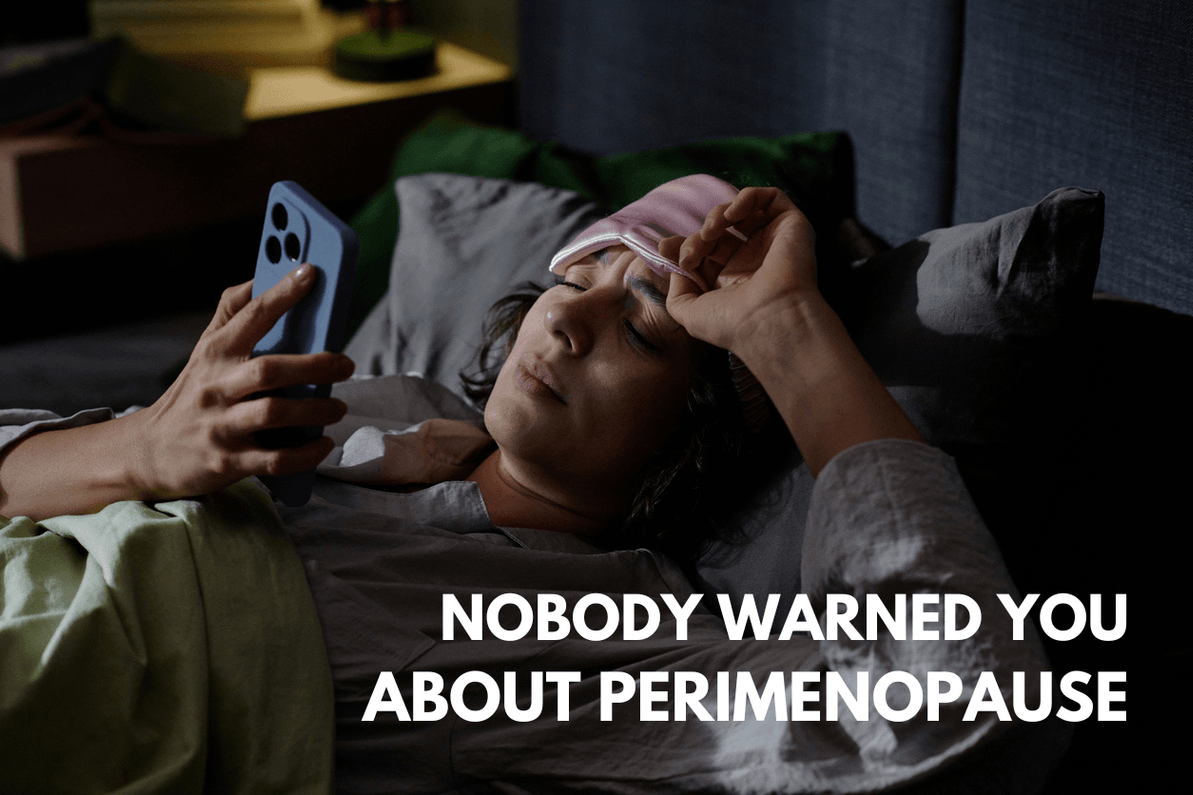
NOBODY WARNED YOU ABOUT PERIMENOPAUSE
Perimenopause has one of the worst PR teams in medical history.
Ask most people what they know about it and you'll hear some combination of hot flashes, mood swings, and maybe a joke about needing to turn the thermostat down.
Meanwhile, millions of women are lying awake at 3 a.m. wondering why they can't sleep, why their shoulder suddenly hurts, why their ears itch, why sex feels different, and WHY THE HELL nobody mentioned any of this before.
And here's the real kicker—this hormonal rug pull can begin up to 10 years before your periods actually stop.
EVERYTHING EVERYWHERE ALL AT ONCE
The problem isn't that perimenopause causes weird symptoms. It's that nobody tells you they're connected.
So instead of recognizing a hormonal transition, many women spend years chasing individual problems. They see a doctor for insomnia, buy supplements for joint pain, shampoo for hair loss, and throw time, money, and energy at symptoms that may all stem from the same place. Expensive? Absolutely. Infuriating? You bet.
It's hard not to be angry about that. Women are expected to navigate a decade-long hormonal transition with less education than they got about puberty, then gaslit when they struggle to make sense of it. After all, it's difficult to connect the dots when nobody hands you the damn map.
HAVE YOU HAD YOUR DEMENTIA SCARE YET?
You probably did, but you already forgot about it. At some point during perimenopause, millions of women experience the same terrifying thought:
"Oh my God. Am I losing my mind?"
Well, yes you are.
You forget words. Names. Streets. You walk into a room and forget why you're there. You stare at an email you've read three times and retain none of it. But you're in good company. According to Dr. Lisa Mosconi, over three-quarters of women develop brain-related symptoms during menopause.
Historically speaking, Western medicine has not exactly covered itself in glory when it comes to female hormonal transitions. Nineteenth-century medicine gave us "female hysteria." If a woman seemed forgetful, difficult, or generally inconvenient, concerned doctors and husbands had a simple solution for that.
(And by "solution," we mean the asylum.)
Funny how many of those "hysterical" women seemed to be in their forties and fifties—prime menopausal territory. The good news is that you're probably not losing your mind. The bad news is that nobody thought to mention that before you spent six months convincing yourself you were developing Alzheimer's.
HOLY SHIT, WHY DID NOBODY TELL US THIS COULD HAPPEN?
Then there's sex.
One of the strangest things about perimenopause is realizing how much of your sexual experience was quietly influenced by hormones all along. Nobody mentions it when everything is working. You find out when something changes. And then, nobody wants to talk about it.
We've all heard of vaginal dryness.
What gets mentioned far less often is what happens when your vagina's "Vacancy" sign suddenly switches off. A wink and fifteen minutes might have gotten you to orgasm before, but now you need complete concentration and a set of jumper cables.
Maybe the things that always worked don't work the way they used to. Maybe your partner is doing everything right while your brain is busy wondering whether you remembered to switch the laundry. It can feel like you're suddenly inhabiting the wrong body.
EXCUSE ME, MY WHAT?
Most women can wrap their heads around hot flashes. Mood swings. Even changes in libido. Then somebody mentions clitoral atrophy.
Cue the screaming.
Because there is a world of difference between, "Sex feels a little different these days," and, "Wait, are you telling me my clitoris can actually disappear?" Instead, many women don't hear about it until they're already sitting in a doctor's office being diagnosed with it.
Honestly, this feels like information that should be printed on billboards.
SERIOUS ISSUES REQUIRE SERIOUS TREATMENT (IF YOU'RE A MAN)
And now we arrive at the part that makes women want to flip tables.
When men experience loss of libido, declining energy, changes in body composition, brain fog, or poor sleep, they're met with testing, treatment options, podcasts, books, and entire industries dedicated to helping them feel better. That's why testosterone clinics seem to be on every corner.
When women show up with the same complaints, they're often met with a shrug and three doctor-approved chestnuts that make us want to pull out what hair we have left.
"Well, as we age..."
"Would you like an SSRI?"
And our personal favorite:
"Have you tried diet and exercise?"
The problem isn't antidepressants, and the problem isn't exercise. The problem is how quickly women's symptoms are dismissed as an inevitable part of aging instead of treated as a legitimate health concern worthy of investigation.
Men lose hormones and get treatment plans. Women lose hormones and get told to buy a fan.
Honestly, it's amazing we haven't burned the whole thing down.
INTERESTING HOW THE QUESTIONS STOP
For most of a woman's life, her reproductive system is treated like a matter of national importance: appointments, screenings, fertility discussions, birth control options, and the endless questions: Are you pregnant? Could you be pregnant? Are you trying to get pregnant?
Then one day the door slams shut.
And suddenly YOU'RE the one asking questions. "How can I sleep through the night? How can I get my libido back? How can I feel like myself again?" And everyone starts acting like you've asked them to solve nuclear fusion.
Funny how everybody was interested in your health when your uterus could still produce a taxpayer.
Fortunately, women are finally calling bullshit. They're comparing notes, finding specialists, asking harder questions, and refusing to accept "that's just aging" as the end of the conversation.
Only one thing is certain:
It shouldn't have taken this goddamned long.
YOU ARE NOT YOUR MOTHER
Talk to most Boomer women about menopause and you'll often hear some version of the same advice: “It's not that bad, I lived through it and you will too.”
But for those of us who distinctly remember being raised by Meno-Monsters™, that version of events can be a little difficult to reconcile. We remember the mood swings, the crying jags, the screaming, and the tension that could fill an entire house.
"LADY, I LIVED WITH YOU."
Do you remember feeling like somebody replaced your mother's personality with a hot curling iron, and now she swears nobody got burned? Then again, rewriting history is practically a Boomer superpower.
But what do you expect? She didn't exactly have a support system. She did what women have been doing for generations: white-knuckled her way through it, complained to nobody, and kept the whole show moving.
Unlike your mother, you now have an entire internet full of women comparing notes. Post some bizarre new symptom on Reddit or Facebook and you'll have a hundred women responding, "Yep, me too," before lunch.
You don't have to stumble through this blind. But nobody is coming to save you either, so you'll have to be your own advocate.
Ask the questions. Read the books. Listen to the experts. Get a second or third opinion when you need one. And for God's sake, don't build your entire menopause strategy around a TikTok video and a melatonin gummy.
Most importantly, understand that millions of women are experiencing exactly what you're experiencing. You are not crazy. You are not failing. And you are definitely not alone.
WHAT IF YOUR DOCTOR IS A PRICK?
At some point, many women work up the courage to bring all of this to their doctor only to be met with a shrug.
So now what?
If your concerns are being dismissed or you leave every appointment feeling more frustrated than when you arrived, get a second opinion.
SO WHO'S THE EXPERT HERE?
And here's something worth considering: maybe your doctor doesn't think menopause is worth talking about. But are they even qualified to have an opinion on it in the first place?
Here's a dirty little secret: a lot of doctors don't know nearly as much about menopause as you think they do. Fewer than 20% of primary care physicians receive formal menopause training.
Doctors are experts in many things. Menopause is not automatically one of them. If somebody isn't listening or isn't willing to discuss your options, find somebody else.
You deserve a provider who treats your quality of life like it matters.
WANT TO LEARN MORE?
If you're still in the weeds trying to figure out whether what you're experiencing is perimenopause, menopause, or you're simply losing your mind, you're not alone. The good news is that there are more resources available today than ever before.
BOOKS
- The New Menopause — Dr. Mary Claire Haver
- The Menopause Brain — Dr. Lisa Mosconi
- Estrogen Matters — Dr. Avrum Bluming & Carol Tavris, PhD
- The Hormone Balance Bible — Dr. Shawn Tassone
PODCASTS
- The Dr. Louise Newson Podcast
- unPAUSED with Dr. Mary Claire Haver
EXPERTS WORTH FOLLOWING
- Dr. Lisa Mosconi
- Dr. Vonda Wright
- Dr. Mary Claire Haver
- Davey Maher
ADDITIONAL RESOURCES
Recent Posts
-
7 Best Ride-On Sex Toys
THE FLOOR IS YOURS. Ride-on sex toys are pretty much what they sound like: t …Sep 15th 2026 -
5 FREE SEX GAMES FOR COUPLES
YOUR MOVE, HOT STUFF. Game night has been tragically overdressed for far t …Sep 3rd 2026 -
HOW TO TAKE SERIOUSLY HOT SEX DOLL PHOTOS
How to Pose and Photograph a Sex Doll Every guy with a decent iPhone camera thin …Aug 21st 2026